
Fats are essential for a healthy body, providing a source of energy and carrying vital nutrients. Fats also play an important role in food manufacture and cooking, making our foods taste good. For good health, it is necessary to pay attention to both the total amount and the type of fats in the diet. An excessive consumption of fats in general and saturated fats in particular is known to be a major factor influencing the development of diseases such as coronary heart disease and obesity.
Sources of saturated fats:
Butter, cheese, meat, meat products (sausages, hamburgers), full-fat milk and yoghurt, pies, pastries, lard, dripping, hard margarines and baking fats, coconut and palm oil.
Sources of monounsaturated fats
Olives, rapeseed, nuts (pistachio, almonds, hazelnuts, macadamia, cashew, pecan), peanuts, avocados, and their oils.
Sources of polyunsaturated fats
Omega-3 polyunsaturated: Salmon, mackerel, herring, trout (particularly rich in the long chain omega-3 fatty acids EPA or eicosapentaenoic acid and DHA or docosahexaenoic acid). Walnuts, rapeseed, soybean, flax seed, and their oils (particularly rich in alpha-linolenic acid).
Omega-6 polyunsaturated: Sunflower seeds, wheat germ, sesame, walnuts, soybean, corn and their oils. Certain margarines (read the label).
Sources of trans fatty acids
Some frying and baking fats (e.g. hydrogenated vegetable oils) used in biscuits, cakes and pastries, dairy products, fatty meat from beef and sheep.
Role of fats in the body
Although in healthy eating terms fat is often closely scrutinized, it is worth remembering that fat has many important functions in the body:
•Fat is the main energy store in the body and the most concentrated source of energy in the diet – 1g of fat provides 37kJ (9 kcal), more than double that provided by either protein or carbohydrate (4 kcal). The body’s fat deposits are used to meet energy demands when dietary energy is limited, for example where people have a poor appetite or during starvation. They may also be needed when energy requirements are high such as during high levels of physical activity and for growing babies and children.
•As well as being an energy reserve, fat deposits cushion and protect vital organs and help insulate the body.
•In the diet, fat is a carrier for the fat-soluble vitamins A, D, E and K, and enables their absorption. It provides the essential fatty acids, linoleic acid (omega-6) and alpha-linolenic acid (omega-3).
ESSENTIAL FATTY ACIDS
Essential fatty acids linoleic acid (omega-6 family) and alpha-linolenic acid (omega-3 family) cannot be made in the body and each must be provided by the diet. They are necessary for growth and development and for maintaining health. Although these two fatty acids cannot be made in the body they can be converted to longer chain versions. These longer chain versions provide the building blocks of eicosanoids, which are precursors for hormones (such as prostaglandins). These hormone like substances are important in the formation of cell membranes and are involved in blood clotting, wound healing and inflammation. Although the body is able to convert alpha-linolenic acid into the long chain versions EPA (eicosapentaenoic acid), and to a lesser extent DHA (docosahexaenoic acid), it seems this conversion is quite limited. For that reason we may also need direct sources of these long chain omega-3 fats in our diet. The richest source of these fatty acids is oily fish (see point 2.3).
Nutritional recommendations
It is now considered that a diet with around 30% of daily energy coming from fat is consistent with good health. Additionally total calories from saturated fat should be kept low, with a tolerable upper limit of 10-11% of daily calories. The intake of trans fatty acids should be kept below 2%.
Bibliographic source: http://www.eufic.org/article/en/nutrition/fats/expid/review-fats/
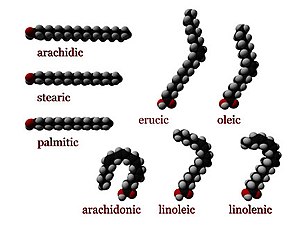
Three-dimensional structure fats acids:
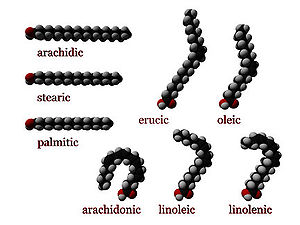
Arachidic, stearic and palmitis are saturated fats.
Erucid and oleic are monounsaturated fats.
Arachidonic, linoleic and linolenic are polyunsaturated fats.
Image source: http://upload.wikimedia.org/wikipedia/commons/thumb/1/19/Rasyslami.jpg/300px-Rasyslami.jpg












 Consejo Nutricional
What’s up, I check your blogs on a regular basis. Your story-telling style is awesome, keep doing what you’re doing!
Me gustaMe gusta
Thank you for your comment. You’re welcome¡
Marina
Me gustaMe gusta